Pages

Showing posts with label research.society. Show all posts

23.5.14

University graduates have more risque sex - but those without a degree are more active between the sheets

www.dailymail.co.uk
Graduates have less sex than non-graduates, new research has revealed (file picture)
  • 13% of non-graduates have sex daily, compared to 10% of graduates
  • 2/3 of graduates have tried bondage but only 37% of non-graduates have
  • 77% of non-graduates had sex outside, compared to 70% with a degree


Graduates often command higher incomes and higher-profile jobs than those without a degree.
But, new research suggests they lose out in the bedroom.
The survey shows those who missed out on university are more likely to have sex every day than those who have a degree.
Some 13 per cent of non-graduates have sex daily, compared to 10 per cent of graduates.
However, graduates are more risky between the sheets with two thirds having tried bondage with 44 per cent claiming to have enjoyed it.
In contrast, only 37 per cent of non-graduates have tried bondage.

22.5.14

sciencedaily.com: Everyday sadists take pleasure in others' pain

Date:
September 12, 2013
Source:
Association for Psychological Science
Summary:
Most of the time, we try to avoid inflicting pain on others -- when we do hurt someone, we typically experience guilt, remorse, or other feelings of distress. But for some, cruelty can be pleasurable, even exciting. According to new research, this kind of everyday sadism is real and more common than we might think.

ScienceDaily: Your source for the latest research news

22.6.13

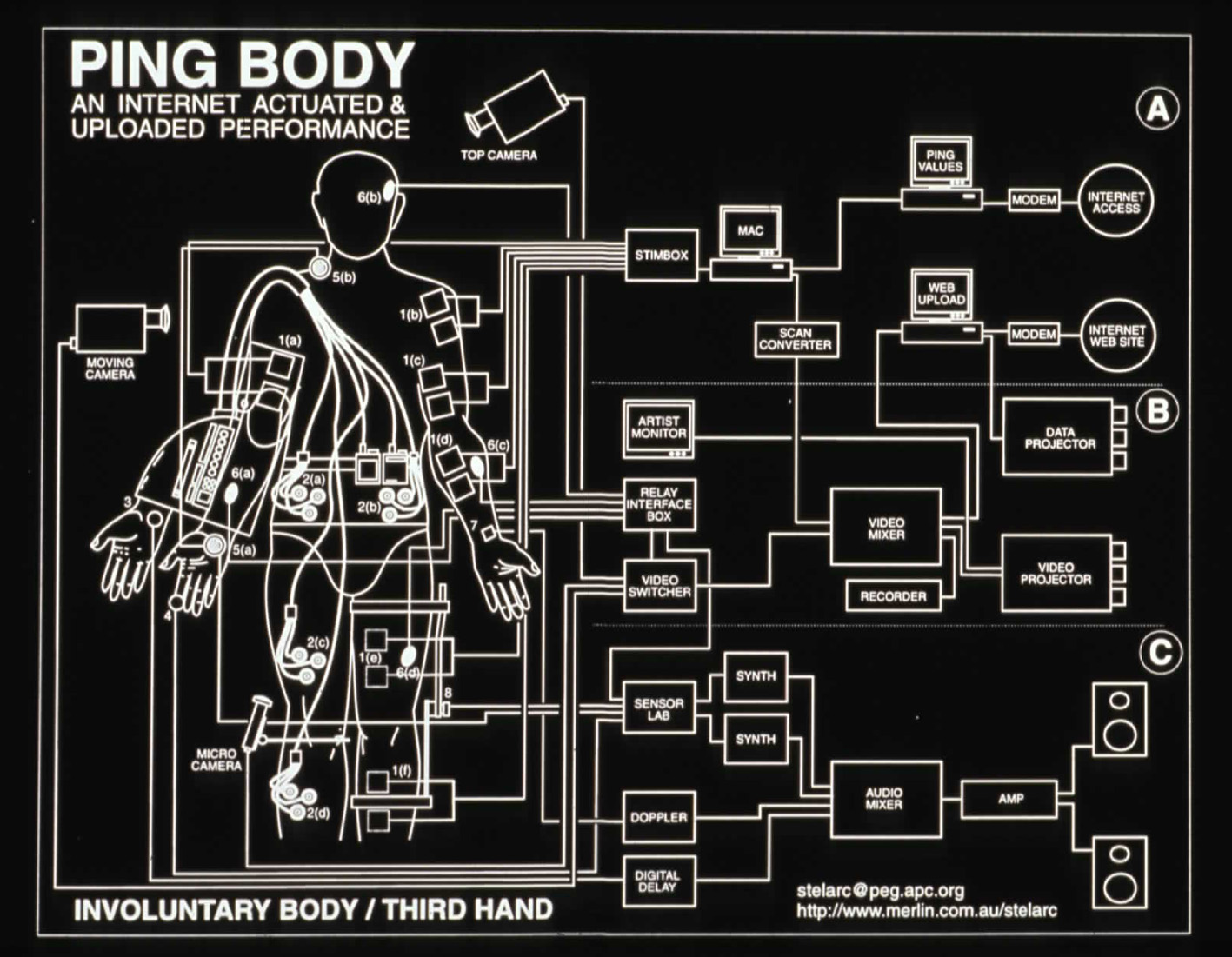
e x p e r i m e n t : Ping Body - Stelarc, 2005


‘Pinging,’ a computer networking term for a signal sent by one computer to determine the presence of another, is made corporeal in Stelarc's Ping Body. A remote audience could access, view and actuate the body of the artist via the Internet. As illustrated in the schematic diagram below, a website provided an interface to a computer-based muscle-stimulation system that permitted those logged on to ‘ping’ various limbs with an electric signal, causing involuntary movements in the artist’s body.  This resulted in a haunting dance that recalled Balinese shadow puppets, made all the more dark by the loud electronic music generated live from network data. While the artist’s body became a robot controlled by the Internet, Stelarc retained control of the robotic third arm, introducing multiple levels of control and communication in the system.  By directly connecting the body to the Internet, it was also subject to the random ‘pinging’ that takes place when URLs are constantly queried by webcrawlers to determine their location and strength of signal. The body itself becomes the object of inspection in the network, rather than the subject that surfs the Web. By exposing and inverting a commonplace practice of the Internet, Stelarc demonstrates, in a highly visceral form, the physicality of online media an d the relationship between embodiment and disembodiment in computer networks. 
moz-screenshot.pngmoz-screenshot-1.pngborg.jpg
[1] Edward A. Shanken, Art and Electronic Media, 2009, p. 155.
---
BDSM, sex and relaxation: news and ideas · (c)Mem's digest

e x p e r i m e n t : Domestic Tension, 2007

Domestic Tension In May 2007 he began a 30-day-long project called Domestic Tension which involved him living in a gallery in Chicago, eating and drinking what was donated to him. Viewers of the piece on the internet were able to view or take shots at Bilal with a remote controlled paintball gun at any time of the day or night. Yellow paintballs were chosen because it is the color of the Support our troops ribbon.


Bilal first got the idea for Domestic Tension when his 21-year-old brother was killed by shrapnel in Najaf, and soon after his father died. The idea solidified after reading a news article about a U.S. soldier in Colorado who remotely fired missiles in Iraq. He originally considered calling the piece "Shoot an Iraqi," but decided that would be too incendiary. Still a book was released under the title "Shoot an Iraqi: Art, Life and Resistance Under the Gun". The book is a combination of an autobiography and his path towards approaching and completing the project.

The number of paintball shots greatly escalated after the work was reported on Digg.com. By the twentieth day, he had been shot at over 40,000 times, and hackers had programmed the gun to fire automatically.[2] By the end, more than 60,000 people from 130 countries shot at him. Bilal lived in the room from May 4 until June 4; afterwards the room remained on display, uncleaned, until June 16.

---
http://en.wikipedia.org/wiki/Wafaa_Bilal#Domestic_Tension
http://www.academia.edu/739023/Wafaa_Bilals_Domestic_Tension_A_politics_of_performance_in_gamic_space - 100p.
BDSM, sex and relaxation: news and ideas · (c)Mem's digest

e x p e r i m e n t : 'Rhythm 0' by Marina Abramović, 1974


To test the limits of the relationship between performer and audience, Abramović developed one of her most challenging (and best-known) performances. She assigned a passive role to herself, with the public being the force which would act on her.
Abramović had placed upon a table 72 objects that people were allowed to use (a sign informed them) in any way that they chose. Some of these were objects that could give pleasure, while others could be wielded to inflict pain, or to harm her. Among them were a rose, a feather, honey, a whip, scissors, a scalpel, a gun and a single bullet. For six hours the artist allowed the audience members to manipulate her body and actions.


Initially, members of the audience reacted with caution and modesty, but as time passed (and the artist remained passive) people began to act more aggressively. As Abramović described it later:
“What I learned was that... if you leave it up to the audience, they can kill you.” ... “I felt really violated: they cut up my clothes, stuck rose thorns in my stomach, one person aimed the gun at my head, and another took it away. It created an aggressive atmosphere. After exactly 6 hours, as planned, I stood up and started walking toward the audience. Everyone ran away, to escape an actual confrontation.”


15.2.11

bdsm : 5 Scientific Reasons Powerful People Will Always Suck

1.Feelings of Power Trigger a Lack of Compassion
A study in an issue of Psychological Science set out to test this idea.
The subjects were then paired up, and one was told to relay an emotionally scarring event that had happened to him. The listener was hooked up to an ECG machine, and all of his stress responses were measured.

The powerless people reacted the way you'd expect people would react when told a heart-wrenching tale. The powerful, on the other hand, felt nothing. Or at least, their responses couldn't be measured, whether they naturally felt no empathy or were just better at regulating their emotions.

The researchers had all of the subjects fill out a survey at the end and inquired about whether they'd like to stay in touch with the other experiment subjects after the experiment was over, to see if maybe they'd made any friends during this ordeal. The powerless subjects were into it. The powerful were not. They wanted nothing more to do with the stranger they'd just traded personal stories with.

2. Power Gives You a False Belief in Your Abilities
Another study found that people with power see the world more positively and are therefore more likely to take risks based on the pure blind faith that things always work out for them because they're awesome.

3. Experiments Show Power and Hypocrisy Are Linked in the Brain
It explains why so many vehemently anti-gay politicians and religious leaders are creepy sexual deviants.
A Dutch researcher mixed things up this time, using five different experiments to try to instill a sense of power in people using different methods, presumably to make sure it wasn't anything particular to a specific kind of role-playing that got the results.

No matter how the researcher went about instilling the feelings of power, the results were the same: Within minutes, a feeling of power flips a switch in the brain that says, "The rules now do not apply to me. BRING ME A WHORE."

But even stranger, the people induced to feel powerless went the opposite way -- they actually were more self-critical than they'd normally be. Think about what that says about society: The people who are already powerless, as a result feel like they're less worthy to be in power and thus stay powerless.

4.Feeling Powerful Makes It Easier to Lie
Researchers at Columbia Business School used a similar setup to the "E" experiment above, where they did a role-play that divided subjects into leaders and subordinates. Leaders were even given a fancy, large office; the underlings got a small, windowless room. All of them were then tempted to lie (they found a $100 bill and were put in a situation where they'd have to lie about it to the people running the experiment if they wanted to keep it).

5.Power and Self-Absorption Go Hand in Hand
First, researchers found that in leaderless situations, those with high opinions of themselves will take charge, for better or for worse.

Read more: 5 Scientific Reasons Powerful People Will Always Suck - Cracked.com


BDSM, sex and relaxation: news and ideas(c)Mem's digest

24.4.10

BDSM Master/slave relationships are the most structured of all relationship types

Latest news in sex research.

Sexology Symposium

Isadora Alman reports latest news in sex research

The very first sexual science symposium I attended was more than twenty years ago. It has remained memorable to me for the following event: The room was filled to capacity. A dignitary from a related field was presenting to the rapt audience of fellow professionals his research on the estrus cycles of apes, their influence on the apes’ mating habits, and its relevance to human sexual choices. “Early every morning,” he began, “I would approach the cages of the female bonobos and, with a very long cotton swab, I would collect a sample of their vaginal secretions…” From behind me a loud whisper interrupted with the comment “For this he went to graduate school?”

The Sexology Symposium for the Society for the Scientific Study of Sexuality, Western Region took place in Palm Springs mid April 2010. Here is a smattering of tidbits I garnered from various presentations, none of which involved the vaginal secretions of apes but struck me as interesting nonetheless.


* An online survey of 1000+ respondents yielded the following results: the median age for cheating for men and women is 36-45. Males are more likely to see cheating as genital contact; females more likely to consider cheating to be emotional connection. Males most often cheat for excitement and to live out their fantasies, women for attention. Males are more likely to feel they can get away with cheating. Females and younger people are more likely to see cheating for any reason as wrong. Older people tend to consider a sexless marriage/relationship justification for cheating.

* Three basic nurturing experiences innate in infancy form the foundation for later emotional, romantic and sexual intimacy: breathing together and holding, eye gazing, and suckling/kissing.

* One of the reasons lust often gets lost in long term relationships is that we learn quite early to inhibit such feelings within the family and that as intimacy increases with a longtime partner and he/she becomes “family” that may trigger those inhibitions.

* Recently some sexual scientists have been using sexual orientation to describe other strong sexual interests beyond a predilection for males, females, or both. The idea that BDSM, pedophilia, bestiality, or a strong fetishistic involvement might be seen as lifelong sexual orientations was explored.

* Among practitioners of BDSM full time Master/slave relationships are the most structured of all relationship types. There can be a variety of subtypes such as Daddy/boy, dominant/submissive, top/bottom.

* Contrary to many popular assumptions, the researchers into relationships among long term gay male couples (8+ years) had no trouble finding such subject couples. Couples who were willing to talk about the negotiations of conducting non-monogamous relationships were harder to find. Those who felt they had successful open relationships exhibited a wide range of non-monogamy styles. Key variables included (1)whether outside sex was conducted jointly, independently, or both, (2)the amount of emotional involvement with outsiders sought and permitted, and (3) the degree to which partners disclosed information. This latter point mirrored a key issue into my own earlier research on both gay and heterosexual couples’ agreements about sex outside the relationship. I found that whether to discuss outside involvements or not to be a major bone of contention. I labeled differing communication styles as Tell-Alls and Say Nothings, those who wanted to share details ands those who definitely did not. Contradicting a widely held belief that non-monogamous gay couples have little or no sex with each other, 75% of the 85 couples in this reported study still had active sex lives together.

* Touch can be healing, affectionate, sensual, erotic, or sexual. It is important to define the difference for oneself.

* Desire is often thought of as an emotion that strikes one, that one feels or does not – on/off, easy to detect, involves fantasy, and focuses on genital feelings. For many women desire is not genital, is slow-acting, exists in discrepancy between thoughts and genital lubrication, and is sometimes the result of sexual activity rather than preceding it.

* A healthy sexuality tolerates flexibility. Sex therapists need to normalize and tolerate ambivalence.

* The plural of anecdote is not data. – Charles Moser, M.D.


Sexology Symposium Psychology Today
BDSM & sex : news & ideas:(c)Mem's digest

20.11.09

The mildly masochistic revolution | Psychoanalytic interpretation of the events of 17 November 1989

Achieved without violence, the fall of the Czechoslovak communist regime had none of the usual arousal associated with revolutions. Journalist Jiří Peňás presents a psychoanalytic interpretation of the events of 17 November 1989.
Published on November 16 2009 Lidové Noviny
Prague, 17 November 1989 : student demonstration demanding Václav Havel's accession to the presidency of Czechoslovakia. On the banner : "Freedom" (AFP)

Down with false modesty! Let's examine the naked truth of the Velvet Revolution. In laying bare the facts, perhaps we can explain why the end of communism proved to be so unsexy. One of the remarkable aspects of the events of November 1989 in the future Czech Republic, and also in Slovakia, was the virtual or complete absence of any sexual dimension. There were none of the sexual expressions that usually accompany revolutions and the collapse of regimes: no orgies, no exhibitionistic women, and no men desperately attempting to lay hands on them in public. No doubt, the chilly temperatures of the Central European autumn did much to negate any excess of libido in what proved to be a surprisingly straitlaced insurrection, but that is not the whole story. The truth is that the issue of sexual freedom was simply postponed, or at least set aside until the dust had settled. So the question is: what became of the sexual liberation which could reasonably be expected after a prolonged period of pious oppression?

23.10.09

***

"СВОБОДА" громадсько-полiтичне видання

Наконец, расхожие взгляды на то, что со временем человечество становится гуманнее и мудрее, оказались иллюзиями: получив громадную материальную силу, включая ядерную энергию, человек в морально-психологическом смысле остался первобытным дикарем, но теперь он размахивает не каменным топором, а “дубиной стратегического назначения”, которая порешит всех — своих, чужих и единственный ареал обитания людей — планету Земля. Впрочем, некоторые историки и антропологи обоснованно считают, что первобытные люди были намного гуманнее современных “гомо сапиенсов”, а Эрих Фромм на богатом фактическом материале пришел к ошеломляющему выводу: с ходом истории агрессивность и жестокость человечества не уменьшаются, как принято думать, а наоборот, возрастают...

13.10.09

What causes masochism? - Yahoo! Answers

Yahoo! Answers :.

Best Answer - Chosen by Asker

Danny by Danny : well masochism is when you have the tendency to hurt or damage your body. It is a medical illness and usually refures to depression or mental illness. An exaple would be girls who cut themselves and dude who fight eachother for fun.... wha causes masochism is the emply feeling (when you have depression) you have that inables you to not feel pain a you infict it on yourself or let other for you

8.10.09

Children Who Are Spanked Have Lower IQs, New Research Finds

Children Who Are Spanked Have Lower IQs, New Research Finds

ScienceDaily (Sep. 25, 2009) — Children who are spanked have lower IQs worldwide, including in the United States, according to new groundbreaking research by University of New Hampshire professor Murray Straus. The research results will be presented Friday, Sept. 25, 2009, at the 14th International Conference on Violence, Abuse and Trauma, in San Diego, Calif.


American children who were spanked had a lower cognitive ability score four years later. (Credit: Murray Straus)

"All parents want smart children. This research shows that avoiding spanking and correcting misbehavior in other ways can help that happen," Straus says. "The results of this research have major implications for the well being of children across the globe."

6.6.09

Cultural Expressions of Masochism | She was raped, but she was not angry. Joanie de Rijke was abducted by Taliban fighters in Afghanistan

via CORRUPT.org: Remaking Modern Society

You hate the world, but realize you're too weak to do anything about it--what do you do? You decide to hate yourself instead and acquire power by appealing to other people's sympathy. Sometimes this psychological deficiency becomes institutionalized. This man, for instance, didn't approve of the marriage his father arranged for him, so he decided to voice his opinion in a way no one could misunderstand: